Self-Guided Food Tour Of Naples: The Free Route, Stop By Stop
The historic centre packs a full eating circuit into about one kilometre. Walked in the right order, on the right day, it costs less than a museum ticket.
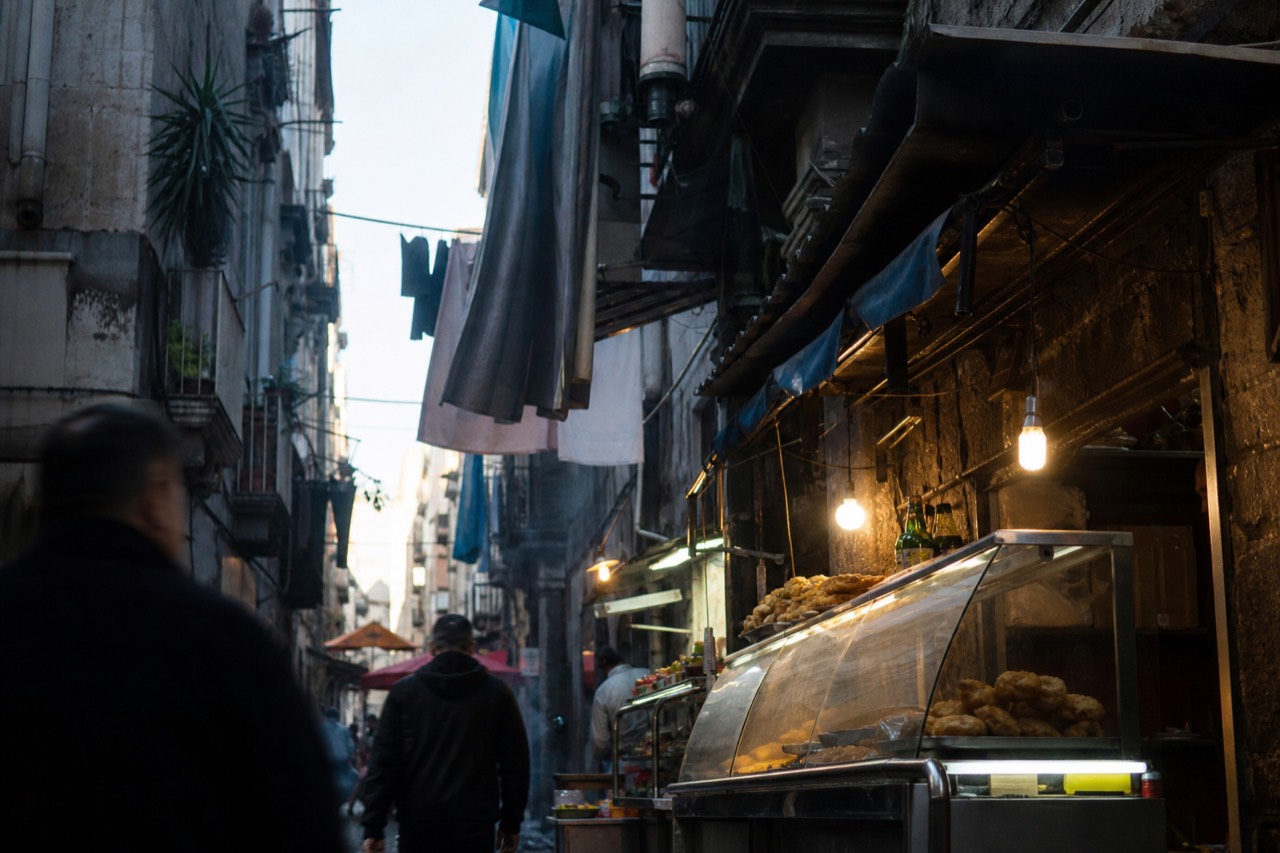
Short answer
A do-it-yourself walk from Piazza Bellini along Via dei Tribunali, down Spaccanapoli and out to the Pignasecca market covers roughly one kilometre and eats well for €12 to €15. Folded pizza runs about €2, a fried cuoppo €3 to €6, a sfogliatella €2 to €2.50 and a babà €2 to €3. Go Monday to Saturday; the market shuts on Sunday.
The distance from Piazza Bellini to the top of the Pignasecca market is about a kilometre. You could cover it in fifteen minutes if you were in a hurry, which is exactly why so many visitors eat one thing on Via dei Tribunali, decide they have seen the street food, and walk on to a museum. The circuit is short. What it is not is obvious.
Keep the independent food plan below, or add a guided experience for the food, place or technique that interests you most.
Booking choice: Taste fried pizza, mozzarella and Neapolitan pastries while an English-speaking guide connects the old streets. Explore Historic Centre Street Food Walk
Everything below comes from what these places actually charge and when they actually open. No stop on this route needs a reservation, none of it needs a ticket, and the whole thing works on foot. What it does need is the right day of the week and roughly the right hour, because half the good doors in this city keep short and specific hours.
Can You Do A Self-guided Food Tour Of Naples For Free?
Yes, apart from the food itself. There is no entry fee, no guide, no booking. A full casual circuit of folded pizza, a fried cuoppo and a pastry is commonly cited at €12 to €15, and under €20 covers a heavy day. The route is roughly one kilometre through the historic centre and works Monday to Saturday.
The reason it works is density. Naples put its cheap eating along two parallel streets, Via dei Tribunali and the Spaccanapoli axis, and then dropped a working market at the western end. Almost every classic format sits inside that strip: pizza folded into a wallet, pizza fried and stuffed, fritters of pasta and rice, cones of fried seafood, ricotta pastry, rum cake.
What you give up is context and access. A stall selling a €2 folded pizza will not explain why the centre is soft, why the market vendor keeps the good anchovies under the counter, or which of the four friggitorie on one corner fries in fresh oil. Those are the things a walk with a local buys, and the honest comparison sits at the end of this page rather than the start.
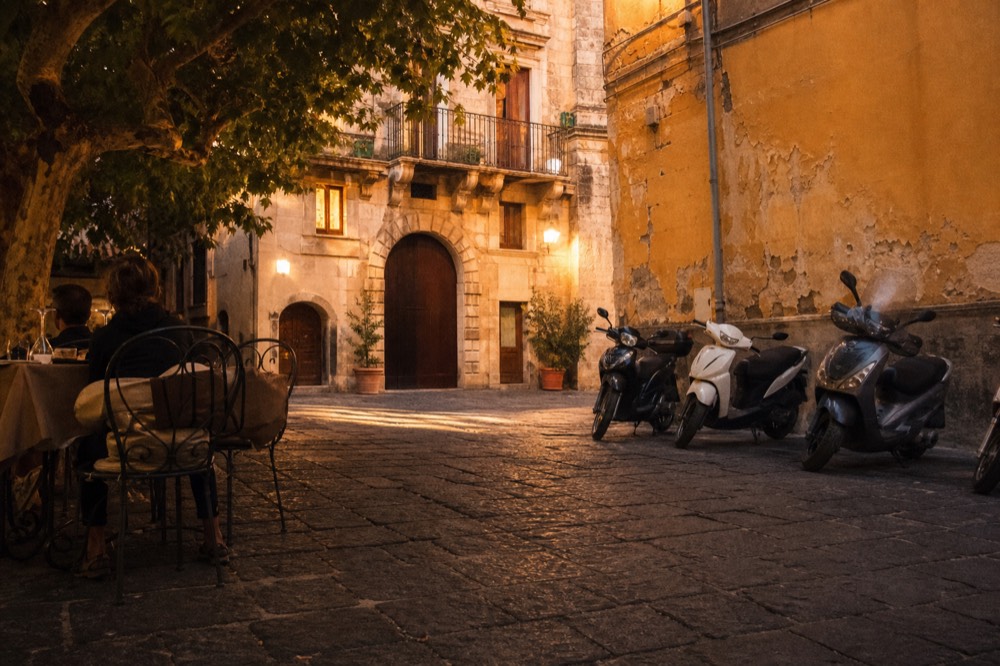
One practical note before the route. Naples recorded around 15 million tourist stays in 2025, about 4% up on the year before, and the historic centre absorbs most of that. The route below has not changed. The crowds on it have.
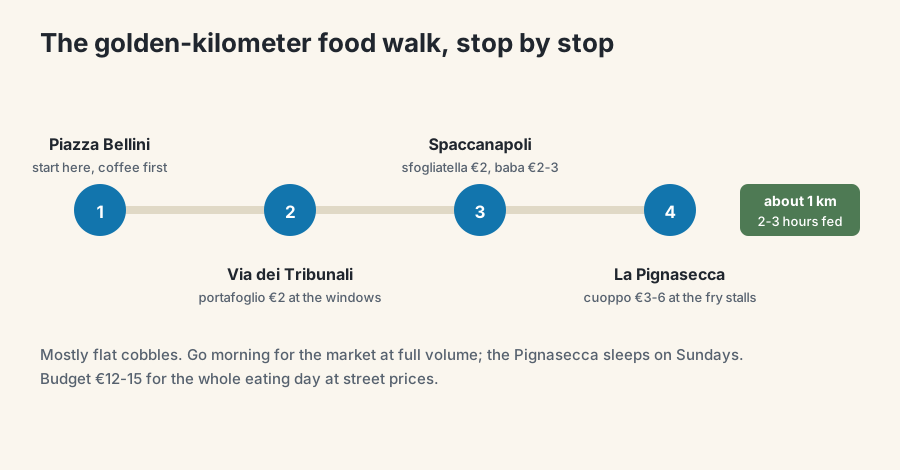
What Is The Golden-kilometre Route, Stop By Stop?
Start at Piazza Bellini, walk east along Via dei Tribunali for folded and fried pizza, cut south to the Spaccanapoli line for pastry, then head west to the Pignasecca market at Montesanto for the fried cones and the produce. Six or seven stops, about one kilometre, two to three hours at an eating pace.
Order matters more than distance. The savoury formats want an empty stomach and the pastry wants a coffee, so the sequence below front-loads fried food and finishes sweet. A sightseeing break between them is optional; allow its full duration before planning another meal.
| Stop | Where | What you eat | Price on record | Notes |
|---|---|---|---|---|
| 1. Piazza Bellini | North edge of the centre, off Via Costantinopoli | Coffee standing at the bar | Bar prices | The natural assembly point; guided walks start here too |
| 2. Via dei Tribunali street window | Di Matteo, Via dei Tribunali 94 | Pizza a portafoglio, folded in four | About €2 | Roughly 9am to midnight daily; eat it walking |
| 3. Friggitoria along the strip | Via dei Tribunali and the Spaccanapoli axis | Pizza fritta, fried and stuffed | €2.50 to €4 | Spots such as Starita a Materdei work the same format |
| 4. Fritter counter | Historic centre rosticcerie | Frittatina di pasta | €2 to €3 | Around €1.50 to €2.50 at places like Rosticceria Vestuto |
| 5. Spaccanapoli pasticceria | Scaturchio, Piazza San Domenico Maggiore | Babà al rum | €2 to €3 | The benchmark room for it |
| 6. Sfogliatella stop | Historic-centre bakeries | Sfogliatella riccia or frolla | €2 to €2.50 riccia, €1.50 to €2 frolla | Ask for it hot; the shells should shatter |
| 7. La Pignasecca | Montesanto, west end | Cuoppo of fried seafood or vegetables | €3 to €6 | Monday to Saturday, roughly 9am to 7pm, closed Sunday |
Add it up and the savoury half of the circuit lands between €7 and €13, with the pastry stops taking it to the commonly cited €12 to €15. Two people can walk the whole thing for the price of one sit-down lunch in the same postcode.
Anyone wanting the dishes explained properly, rather than listed, should read the dish-by-dish street food breakdown alongside this route. It covers what each format actually is and how to tell a good one.
Where Does The Walk Start, And What Do You Eat First?
Piazza Bellini, then east into Via dei Tribunali. The first thing to eat is a pizza a portafoglio from a street window, about €2, folded into quarters and eaten standing. The Di Matteo window at Via dei Tribunali 94 serves it from roughly 9am to midnight, which makes it the most reliable first stop on the route.
Piazza Bellini is the right starting point for the same reason the guided walks use it: it is easy to find, it has shade, and it sits at the top of the funnel into the old street grid. Have a coffee at the bar standing up, because that is both the local habit and the cheaper price.
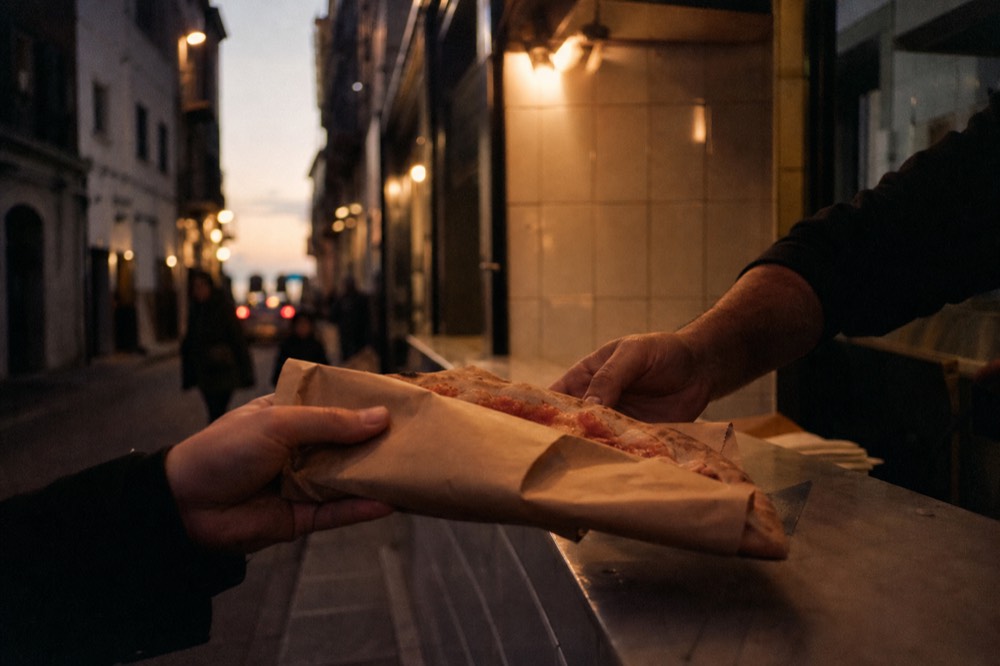
Then the folded pizza. A portafoglio is a full-size Neapolitan pizza folded twice into a wallet, wrapped in paper, and handed over hot. At about €2 it is the cheapest serious food in the city, and it is a different product from the €6.50 sit-down margherita a few streets away. Same dough, same oven, different job. The distinction, and what the famous rooms charge, is laid out in the famous pizzerias compared.
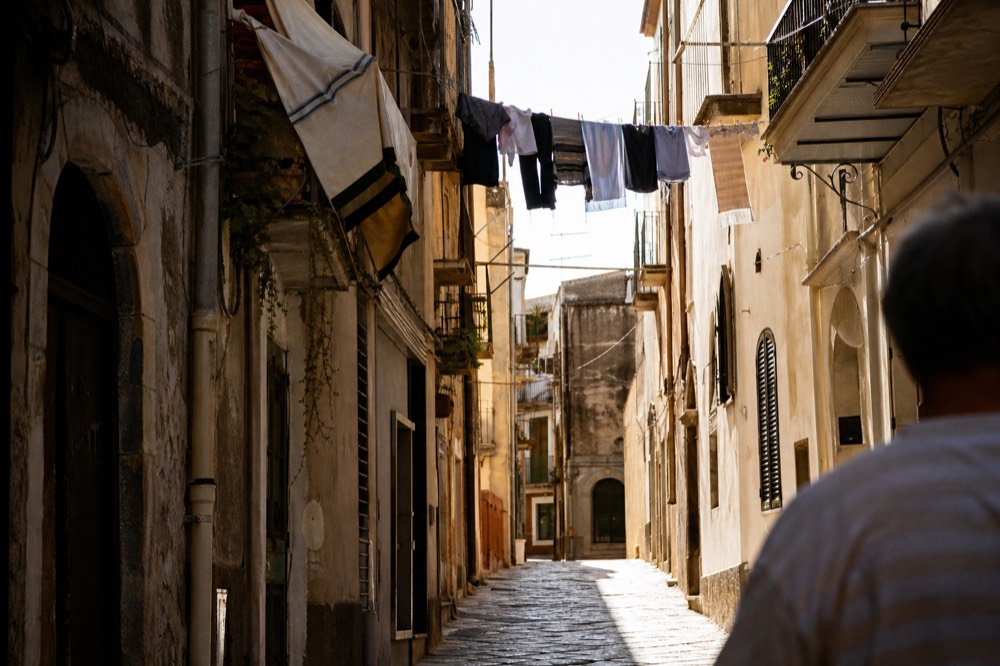
Eat it standing, off the paper, folded point-first. The craft behind it carries a UNESCO intangible heritage listing awarded in 2017, which is a slightly grand thing to think about while grease runs down your wrist on a street corner, and also completely accurate.
Which Spaccanapoli Stops Are Worth The Detour?
Spaccanapoli, the dead-straight street that splits the old city, is the pastry leg. Scaturchio on Piazza San Domenico Maggiore is the benchmark for babà at €2 to €3, and the fried-pizza windows along the axis run €2.50 to €4. Sfogliatella riccia costs €2 to €2.50, frolla a little less.
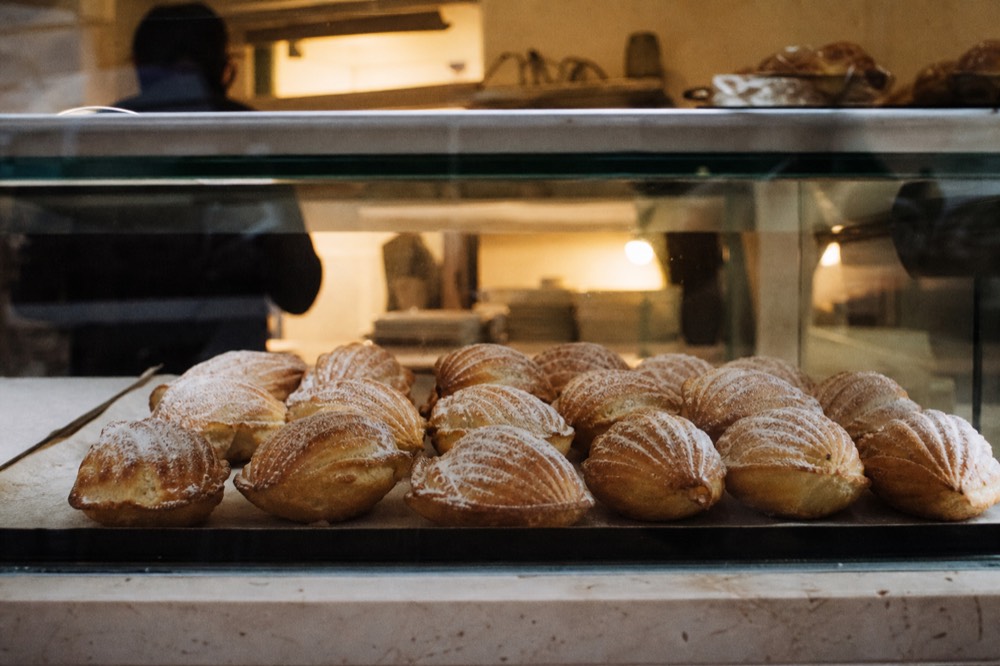
The two pastries are not interchangeable and visitors get talked into the wrong one constantly. Riccia is the ridged, layered shell, shattering and slightly chewy, best within minutes of the oven. Frolla is the soft shortcrust version, rounder and easier, cheaper by roughly fifty cents. Locals argue about which is correct. The useful answer is that riccia rewards timing and frolla forgives it.
Babà is the other Spaccanapoli obligation: a yeasted cake soaked in rum syrup, sold from €2 to €3, sometimes split and filled with cream. It is heavier than it looks, so it goes at the end of the leg rather than the middle.
There is a coffee rhythm to this stretch too. Espresso standing at the counter, small and fast, and typically another one two stops later. That pattern, and what the city actually eats before noon, is covered in what a Naples breakfast looks like.
How Does The Pignasecca Market Leg Work?
La Pignasecca, around Montesanto, is the city's oldest open-air market and the least touristy stop on the route. It runs Monday to Saturday, roughly 9am to 7pm, and closes on Sunday. Fresh produce, fish and meat dominate, with frying stalls attached, and a cuoppo of fried seafood or vegetables costs €3 to €6.
This is the leg that separates a real food walk from a photo walk. Pignasecca is a working market serving people who live here, not a curated food hall, so the pace is brisk, the prices are local, and nobody is performing. Fish gets gutted in front of you. Vendors shout over each other. It is the loudest twenty minutes of the route and the best value.
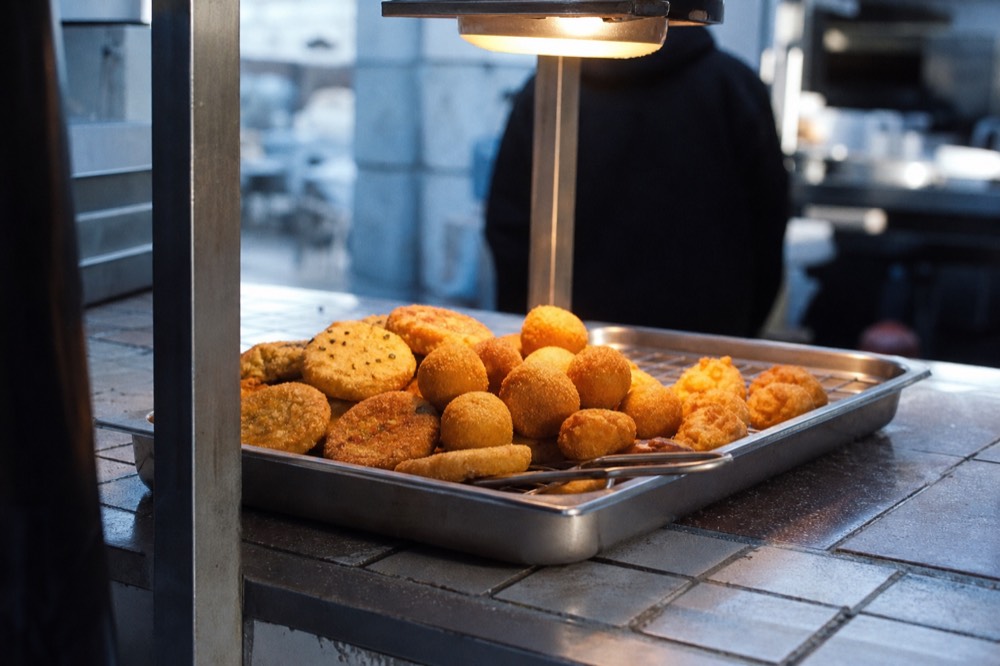
The cuoppo is the thing to buy. A paper cone, filled to order with fried anchovies, squid, courgette flowers, potato croquettes or whatever the fryer is working through, handed over hot enough to hurt. Small cones start around €3 to €4 and a full mixed one runs up to about €6. Friggitorie sit right alongside the market, including long-standing names like Fiorenzano.
Morning is when it works. By late afternoon the produce stalls are winding down and the crowd thins, which sounds pleasant and mostly means less choice. If markets are the part of a city you enjoy most, how the city's markets work goes into the others too.
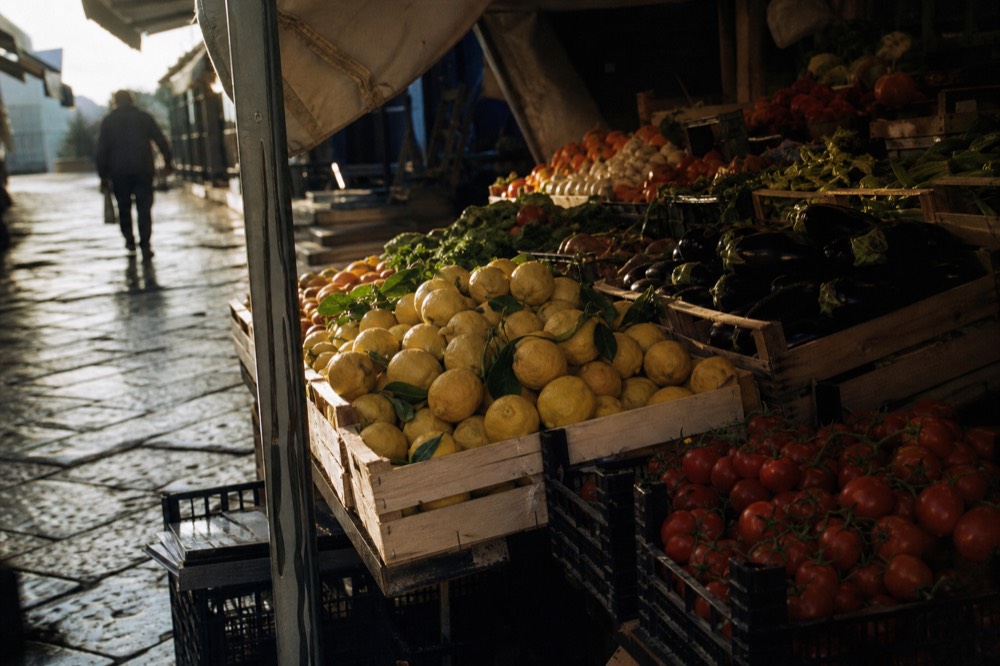
A two-hour guided Pignasecca route includes six tasting stops. It concentrates on the market; it does not reproduce every stop in this independent route.
When Should You Walk It, And What Should You Avoid?
Walk it Monday to Saturday, starting between 9am and 10am, with the market leg before 1pm. Sunday closes the Pignasecca and Friggitoria Vomero. Monday closes Attanasio. Cruise days compress the historic centre badly, and 2026 is forecast at about 1.75 million cruise passengers across 510 calls.
The timing matrix below is the single most useful thing on this page. Most failed self-guided walks in Naples fail on a closed door, not on a bad choice of dish.
| Time slot | What is open and worth it | What to skip |
|---|---|---|
| 6:30am to 9am | Attanasio near Stazione Centrale opens around 6:30am, Tuesday to Sunday, for hot sfogliatella | Everything else; the centre is still shuttered |
| 9am to 1pm | Pignasecca at full strength, street windows open from about 9am, fryers going | The famous sit-down pizzerias, already filling |
| 1pm to 3pm | Lunch peak; fried food moves fast and queues form | Any plan that depends on walking quickly |
| 3pm to 5pm | The afternoon lull, the calmest window in the centre | The market, winding down |
| 4:30pm to 9:30pm | Friggitoria Vomero's evening session, Monday to Saturday | Trying to combine Vomero with a centre market stop |
| 5pm to midnight | Via dei Tribunali windows, Di Matteo until around midnight | Nothing much; this is the strip's best hour |
| Sunday, any hour | Street windows on the Tribunali axis | Pignasecca and Friggitoria Vomero, both closed |
Cruise-ship days deserve their own line. Summer averages roughly three cruise liners docking daily, and tens of thousands of passengers head for the same kilometre you are walking. You cannot change that, but you can walk the route before 11am and be finished by the time it peaks.
On safety, the useful framing is undramatic. Petty crime, mainly pickpocketing and bag snatching in crowded spots, is the real risk; violent crime against visitors is rare. Quartieri Spagnoli has improved a lot and is now one of the better street-food quarters, though small alleys at night still deserve the caution you would give any dense old district. A dedicated tourist police unit rolled out through 2025. The longer version is in an honest read on safety in Naples.
What Does The Whole Route Cost?
Between €12 and €15 for the full casual circuit, and under €20 for a heavy eating day. The savoury half runs €7 to €13, pastry adds €4 to €6, and coffee standing at the bar is a euro or two a time. Nothing on the route needs a booking, so there is no sunk cost if the weather turns.
| Budget level | What it buys | Rough total |
|---|---|---|
| Light, two stops | Pizza a portafoglio plus a sfogliatella riccia | About €4 to €4.50 |
| Standard circuit | Folded pizza, a cuoppo, one pastry | €7 to €11 |
| Full circuit, commonly cited | Folded pizza, fried pizza, fritter, cuoppo, two pastries | €12 to €15 |
| Heavy day, everything twice | The circuit plus a second savoury round and coffees | Under €20 |
| Sit-down comparison | One margherita at a famous room, about €6.50 plus €1 cover | €7.50 for one dish |
Two costs sit outside the food. Accommodation carries the city tourist tax, set for 2026 at €4.00 to €6.00 per person per night depending on the class of property, and public transport is separate. Neither affects the walk, but both belong in a day budget.
Naples is also cheaper than the comparable Italian city-break destinations for casual eating, which is a qualitative point rather than a precise one. The €2 folded pizza has no real equivalent in Rome or Florence at that price and that quality. For the pizza-specific arithmetic, see what a pizza actually costs here.
What Happens On A Sunday Or A Monday?
Sunday closes the Pignasecca market and Friggitoria Vomero. Monday closes Attanasio. The Via dei Tribunali street windows stay open daily, so the folded and fried pizza half of the route survives both days. Rebuild the walk around the strip and drop the market leg rather than trying to force it.
Most itineraries you find online quietly assume a Tuesday. The table below is what to do when your trip does not cooperate.
| Closed on the day | What you lose | The substitute that works |
|---|---|---|
| Sunday: La Pignasecca | The market leg, produce stalls, adjacent fryers | Friggitorie along the Tribunali and Spaccanapoli axis, open daily |
| Sunday: Friggitoria Vomero | The classic hillside cuoppo | Centre friggitorie for the same €3 to €6 cone |
| Monday: Attanasio | The 6:30am hot sfogliatella queue | Historic-centre pasticcerie later in the morning |
| Any day, mid-afternoon | Market energy, fresh frying at some counters | Move the walk to the 3pm to 5pm lull for the strip instead |
| Cruise-heavy day | Space, and any sense of calm | Start at 9am, finish the centre by 11am |
The other Sunday option is to stop fighting it. Sunday lunch is a family institution here, restaurants fill with three generations at one table, and the street-food economy takes a quieter day. A guided evening format sidesteps the whole problem, and the private and evening food tours page covers the ones that run when the market does not.
Is There A Shorter Vomero And Seafront Variant?
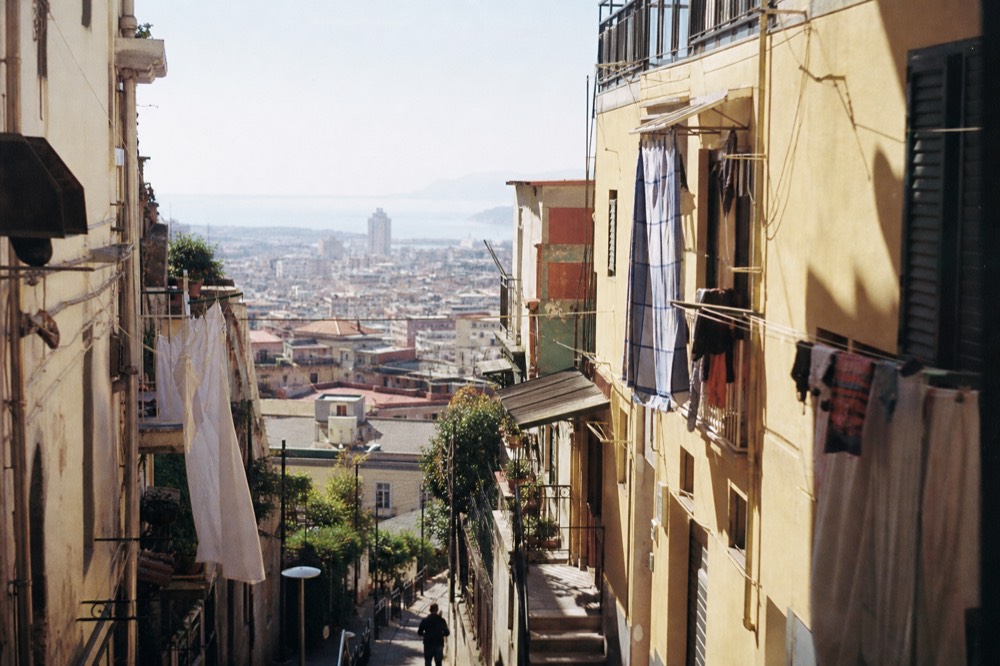
Yes. Ride up to Vomero, eat a cuoppo at Friggitoria Vomero on Via Domenico Cimarosa 44 for €3 to €6, then walk down toward the seafront. It is roughly a two-hour version with better air and fewer crowds, open Monday to Saturday, about 10:00 to 14:30 and 16:30 to 21:30, closed Sunday.
This is the variant to use on a hot afternoon, on a cruise-heavy day, or when the historic centre has simply worn you out. Vomero sits above the old city, the streets are wider, and the fried food is as good as anything in the centre. The trade is density: you get one great stop rather than seven, so treat it as a supplement to the main route rather than a replacement.
Time it around the split hours. That 14:30 to 16:30 gap catches people out constantly, and there is no fallback of the same quality within a short walk. Aim for late morning or from 17:00.
Walking down toward the seafront afterwards gives the other thing the historic centre cannot: horizon. It is not a food leg, it is a digestion leg, and after a cuoppo that is exactly what you want. Which parts of the city eat what, and why the hill and the centre differ, is the subject of which neighbourhoods eat what.
How Do You Get Between The Stops?
On foot, mostly. The core route is about one kilometre and the walking is the point. Metro Line 1 covers the centre with the Dante and Toledo stations, and Line 6 has run fully since July 2024. The Line 1 airport station was over 95% complete in November 2025 but is not open yet, so do not plan around it.
| Leg | How to do it | What to know |
|---|---|---|
| Piazza Bellini to Via dei Tribunali | Walk, a few minutes | Dante on Metro Line 1 is the nearest station to the start |
| Via dei Tribunali to Spaccanapoli | Walk, two parallel streets | The connecting alleys are short and worth taking slowly |
| Spaccanapoli to Pignasecca | Walk west, about ten minutes | Toledo on Line 1 sits between the two |
| Centre to Vomero | Uphill transfer | Plan it as a separate half-day, not a hop |
| Airport to the centre | Not by metro | The Line 1 airport station is over 95% built, not open; about nine minutes once it is |
| Anywhere at peak | Walking beats everything | Scooter traffic in the alleys is constant; stay to the wall |
Two metro stations on this route are attractions in their own right. Toledo and Dante are part of the city's art-station programme, and Toledo in particular is worth the fare even if you were going to walk. That is the rare case in Naples where the transport is the sight.
Shoes matter more than any of this. The basalt paving is uneven, worn slick in places, and wet after rain. Everything on this route is doable in trainers and unpleasant in anything else.
When Does The Guided Version Actually Win?
A guide can be useful when time is short or you want help ordering and understanding the food. Choose a route that operates on your actual date, especially on Sunday. The independent circuit remains an option for full control over stops, timing and spending.
The honest accounting is that you are not paying for the food. You are paying for sequencing, for the vendor relationships, and for someone answering questions in your language while you eat. On a five-day trip with plenty of slack, the self-guided route wins easily. On a two-day trip, or on a Sunday, or with the market shut, the calculation flips.
The Piazza Bellini food walk covers the historic centre with a guide. The Pignasecca walk concentrates on the market, while the private option gives your group its own host. Pick the route before comparing current quotes. Related reading: guided street food walks.
Either way, walk the route once on your own first if you have the days for it. It costs about the price of two coffees in most European capitals, it takes an afternoon, and it will tell you very quickly whether you want the guided version, a hands-on pizza or pasta class, or simply to do the whole thing again tomorrow. The rest of what this city eats is catalogued in the full list of Naples dishes, and every food experience we compare sits on the front page.
Choose Your Naples Experience
Historic Centre Street Food Walk. Taste fried pizza, mozzarella and Neapolitan pastries while an English-speaking guide connects the old streets. Have a date in mind? Check it before arranging the rest of your Naples day.
150 minutes. Meet by the Greek ruins in Piazza Bellini; follow your confirmation if meeting details change. 2.5 hours walking and standing; seats are not guaranteed. Vegetarian requests need advance notice; no vegan, gluten-free or dairy-free diets. Extra drinks cost extra.
Choose a date to see scheduled departures. Final availability and price are confirmed on Viator.
No verified experience fits those requirements. Adjust your choices, or keep the independent plan described above.
Compare Options And Fit Your Plans
General recommendation until you choose. Confirm the exact option, meeting point, inclusions and dietary arrangements when booking. A food walk does not promise a visit to a particular celebrity pizzeria. Allow travel time on top of the activity duration.
- Pignasecca Market And Six Tastings: 120 minutes. Explore the working market with a guide, from folded pizza and a seafood cone to a sweet finish. Meet outside San Liborio church, Piazza Carità 12. Select the vegetarian option when needed. Food and drinks listed in your chosen option are included; extra orders are separate. A market walk, not a shopping-and-cooking class.
- Private Naples Tasting Walk: 180 minutes. Explore with your own host, choosing the listed six- or ten-tasting option for your group. 3 hours; choose the ten-tasting option if you want ten tastings. Private refers to your group and guide. Confirm the route and meeting point with your host; specific shop visits, hill transfers and queue priority are not promised. Dietary needs require prior agreement.